
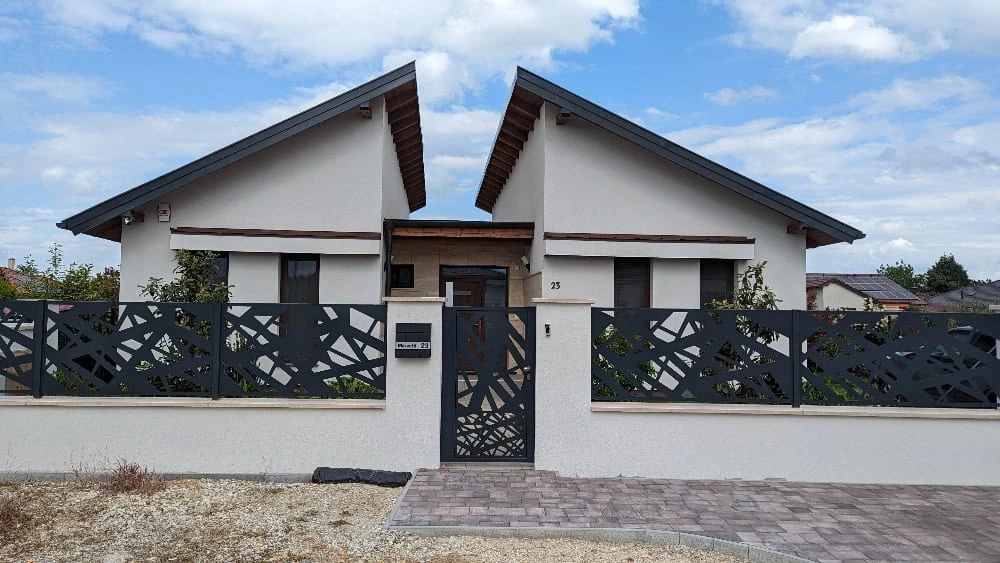
Modern architecture and garden design favour solutions that combine minimalist aesthetics with durability. The popularity of outdoor metal fence panels is no coincidence: today’s modern fencing solutions no longer just mark a boundary, they are also the visual calling card of a property.
However, for a custom fence design to be millimetre-accurate and durable in reality, serious manufacturing technology is required.

If you would rather browse products than gather information, visit the website of our partner Nordark, where you can choose from numerous designs.
In this article we show how raw steel sheet is turned into a premium, modern fence element through precision CNC metalworking.
Choosing the material: not every steel fence panel is the same
The very first and one of the most important steps of the manufacturing process is choosing the right material. For durability, sheet thickness is a critical factor: a sheet that is too thin may warp under wind load or the heat generated during cutting, while one that is too thick needlessly increases the weight and cost of the structure.
At Ferolaser, industrial experience shows that for fence production the ideal choice is steel, aluminium or stainless steel sheet of a carefully selected thickness. Precise material preparation ensures that the later surface treatment adheres perfectly, preventing corrosion.
The CNC laser cutting process: how the precision pattern is born
The heart of modern sheet metal processing is the computer-controlled CNC laser cutting machine. Once engineers have prepared and optimised the patterns in CAD software, the designs go straight to production.
In Ferolaser’s workshop, top-class Trumpf laser cutting technology is at work. This is what guarantees that the cut edges remain perfectly clean, burr-free and sharp.
Moreover, these high-tech machines use an intelligent nesting system that minimises waste – the foundation of sustainable and cost-effective custom metalworking.
What to watch out for when designing and manufacturing a laser-cut fence?
To achieve a durable and attractive result, the manufacturer has to weigh several engineering considerations:
- Pattern density and wind load: Patterns that are too dense can weaken the structural integrity of the sheet, while surfaces that are too solid catch the wind like a sail. Finding the structural balance is key.
- Protecting the cut edges: Microscopic inaccuracies come back to haunt you during later surface treatment (such as powder coating), where the paint can chip off more easily.
- Fixing points: The fixing of the panels must be planned already in the cutting phase, so that the finished parts do not need to be welded or drilled afterwards during installation.
Surface treatment: the secret of a long service life
Raw, laser-cut steel sheet on its own is not yet a weatherproof fence. To withstand rain, UV radiation and frost for decades, professional surface treatment is needed.
After precise CNC laser cutting, the panels undergo thorough chemical cleaning and degreasing, followed by powder coating (sintering). The baked-on powder coat layer evenly covers even the smallest inner cut edges, guaranteeing a maintenance-free, premium appearance.
If you would like to complement your technical knowledge with inspiration and see how these structures look in practice, it is worth exploring the architectural potential behind the advantages of laser-cut fence panels and their design possibilities.
Frequently asked questions (FAQ)
How long does a laser-cut fence last?
Steel and aluminium panels cut with professional technology and properly surface-treated (powder-coated or galvanised) last for several decades. They require minimal maintenance and do not need to be sanded or repainted every year.
Does a laser-cut steel fence rust?
Raw steel would rust when exposed to the weather, but the powder coating applied after the precise manufacturing process hermetically seals the metal surface, providing complete corrosion protection.
What thickness of sheet are fence panels made from?
In fence production we most often work with sheet thicknesses between 1.5 mm and 3 mm. This range offers the best balance between structural stability, wind load resistance and precise cuttability.
Can fence panels be made with a custom pattern?
Yes. Thanks to modern CNC technology, almost any supplied CAD/DXF design, custom geometric shape or organic pattern can be cut with millimetre accuracy, so a completely unique fence design can be realised.
Summary: where engineering precision meets design
Serious manufacturing technology therefore stands behind the aesthetics of modern outdoor metal fence panels. The key to a long service life and a premium appearance is top-class CNC metalworking, flawless cut edges and professional surface treatment. Once the technical foundation is in place, the range of possibilities in shapes and patterns is endless.
Looking for inspiration for your home’s fence?
Now that you know the behind-the-scenes secrets of precision manufacturing, discover the latest trends and design language! Browse the full catalogue of modern laser-cut fence solutions and find out how to make your property’s appearance completely unique with Nordark’s detailed guide.
